
In HPHT synthetic diamond production, humidity is not the most critical technical variable — but it is a stability factor that has long been underestimated.
Synthetic pyrophyllite assembly components are moderately hygroscopic. When moisture content is elevated, water vaporizes and expands under high-temperature, high-pressure conditions, potentially causing:
- Assembly cracking
- Internal micro-bubbles
- Black spots or fine inclusions
- Reduced batch consistency
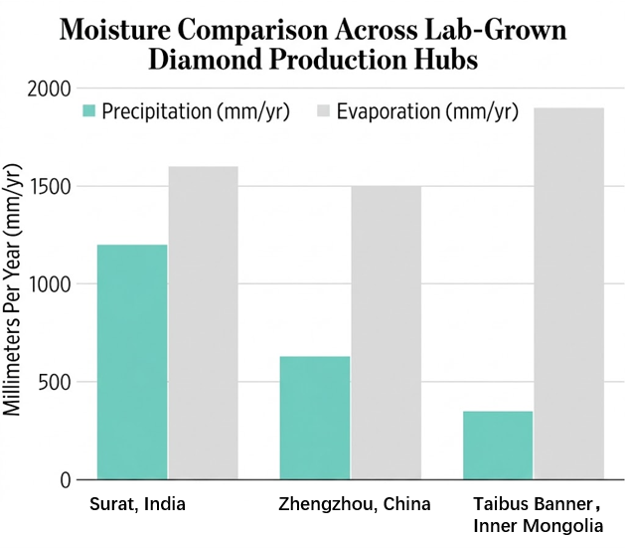
In southern regions, where ambient humidity remains high year-round, production environments must rely on continuous dehumidification systems to control material moisture levels — otherwise, fluctuations translate directly into yield losses.
Our decision to establish our facility in Taibusi Banner, Inner Mongolia was not made for marketing purposes. It was based on a straightforward reality: the climate here is persistently dry, with relative humidity significantly lower than that of southern production regions.
This naturally low-humidity environment offers three practical advantages:
- Lower risk of raw material moisture absorption
- Reduced batch-to-batch moisture variation
- Decreased dependence on industrial dehumidification systems
It does not replace press technology, nor does it determine the ceiling of crystal quality — but it eliminates one unnecessary source of variability.
In large-scale mass production, what truly differentiates operations is rarely a single breakthrough. It is the long-term control of stability.
Inner Mongolia’s dry climate means one fewer obstacle on that front.